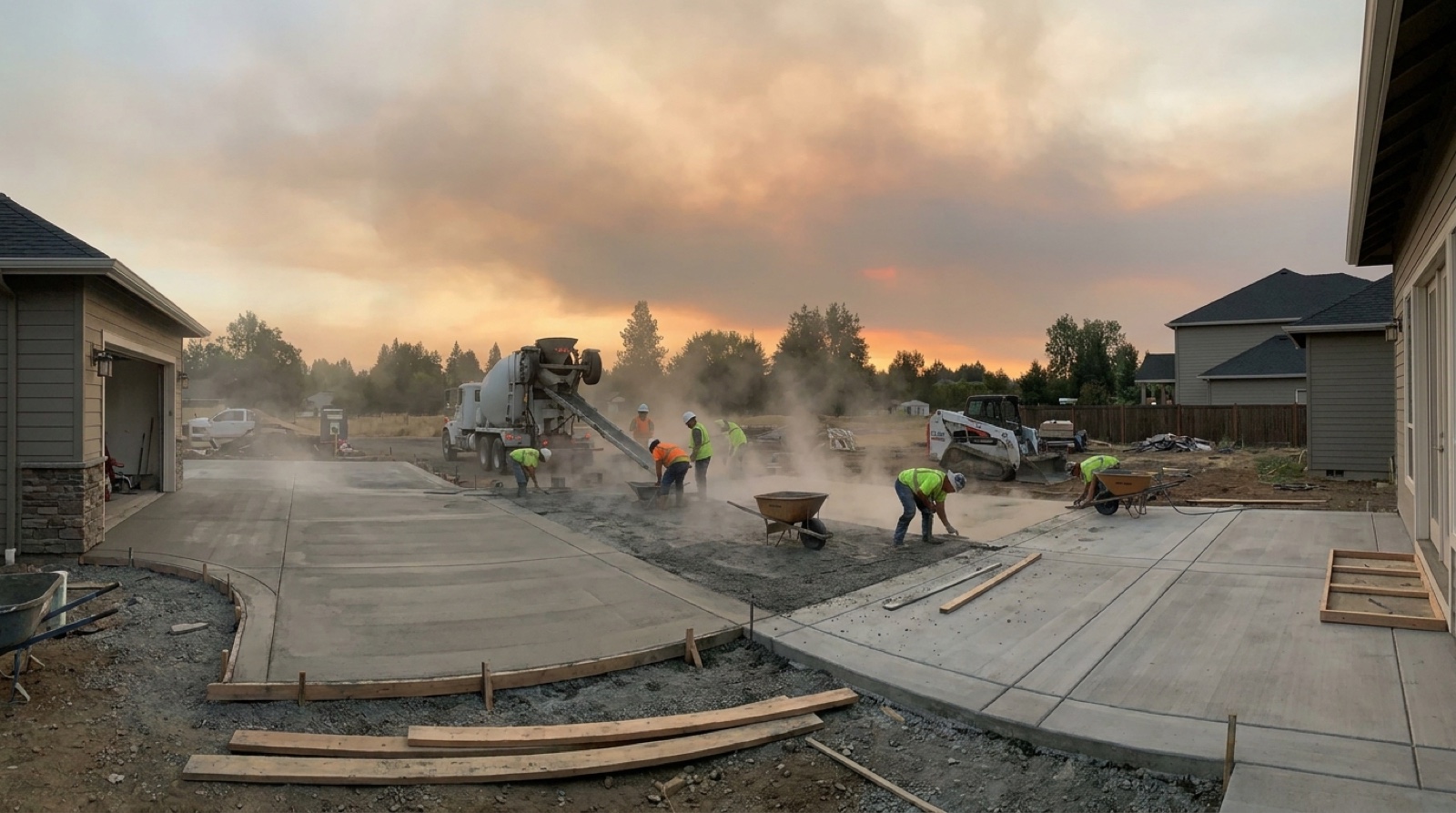
Wildfire smoke does not damage cured concrete. It does change how a fresh pour behaves, and it is a real reason to move sealing and staining work to a clearer day.
Western New York spent much of this past week under haze drifting down from Canadian wildfires. Air quality dropped far enough that local coverage tracked the numbers and the health warnings that came with them, with forecasters expecting the haze to thin gradually into the weekend.
Haze Is Not a Reason to Cancel a Pour
Concrete cares about temperature, wind, humidity and direct sun. Smoke particles in the upper air do not react with cement paste in any meaningful way.
What smoke does do is scatter sunlight. A heavy haze layer knocks a few degrees off surface temperature and softens the direct sun that normally bakes a slab in July.
For a Buffalo driveway pour in the middle of summer, that is usually a small help rather than a problem. Slower surface evaporation means a longer finishing window and less risk of plastic shrinkage cracking.
The catch is that haze rarely arrives alone
The same stagnant air pattern that traps smoke over the Niagara Frontier also tends to bring low wind and high humidity. That combination slows bleed water evaporation, which pushes back the point where a crew can start troweling.
A pour that would normally finish by early afternoon can run into the evening. If you are having a new driveway poured at your home, expect the crew to work later on those days rather than rush the finish.
The Jobs You Should Actually Move
Anything involving a wet coating on a surface is the real casualty of a smoke event. Airborne particulate settles onto tacky sealer and stays there permanently.
| Task | Smoke Day Call | Why |
|---|---|---|
| Placing and finishing concrete | Proceed | Diffused sun helps more than particulate hurts |
| Sealing a driveway or patio | Postpone | Ash and dust embed in the wet film |
| Staining or coloring | Postpone | Settled particulate causes blotching |
| Demolition and removal | Proceed with dust control | Adds to an already loaded air column |
| Forming, excavation, rebar | Proceed | No surface chemistry involved |
Sealer is the one to be firm about. A cheap decision to seal under a hazy sky shows up as a permanently speckled surface that only grinding will fix.
That matters most on decorative work. If you have invested in a stamped surface with color hardener and release, the sealer coat is what carries the whole look, and contamination in that film is not something you can buff out later.
Rinse Before the Ash Sets In
Fine ash that settles on existing concrete is mostly cosmetic. It becomes a staining problem when it sits through a rain event and then dries in place.
The fix is simple. Hose down patios, walks and driveway aprons once the air clears, and do it before the next storm rolls through off the lake.
Use plain water and a stiff broom first. Reach for a degreaser only if you find actual residue, since aggressive cleaners strip sealer faster than smoke ever will.
Pay attention to what the rinse reveals. Ash collecting in a line across a slab usually means water is pooling there, and standing water on a Buffalo patio is the first step toward freeze damage in January.
Why Timing Matters More Here Than Most Places
Buffalo gives contractors a working season, not a working year. Between reliable spring thaw and the first hard freeze, there is a finite number of days suitable for placing concrete.
Losing a week to smoke, heat or storms compresses everything behind it. That is the practical argument for booking work in July rather than waiting for September to feel more comfortable.
| Month | Best Suited For |
|---|---|
| May and June | Excavation, footings, large flatwork |
| July and August | Patios, walkways, decorative work |
| September | Repairs, sealing, smaller pours |
| October | Final pours, weather dependent |
Late summer is a good window for adding a backyard patio because the ground has fully dried out and cure conditions are stable. It is also when we handle most front walk and approach replacements in Amherst, Tonawanda and Cheektowaga, since those jobs need dry subgrade to compact properly.
What To Do If Your Job Is Already Scheduled
Ask your contractor two questions. What is the plan if air quality drops again, and which stages of your job actually depend on clear air.
Most of a project is unaffected. Grading, forming, reinforcement and placement all continue normally under haze.
If your job includes sealing or decorative finish work, agree in advance that those steps get their own weather window. A one or two day delay on a coating is far cheaper than living with a flawed surface.
The same logic applies to crack and spall repair on existing slabs, where patching compounds and overlays need clean, dry conditions to bond.
If you are planning work across the greater Buffalo metro this season, reach out for a quote and we will build the schedule around real conditions rather than a fixed calendar date.